Kayin, Hidden Soul-Roots, and the Mysterious Path of Tikkun
Do we really know who we are? Most of us think we do. But if you think about it a little, you'll realize that we know almost nothing about our soul-root: why we carry certain personality traits and where our deeper struggles come from. All we really know are our habits, strengths and weaknesses, ambitions, and recurring patterns of behavior.
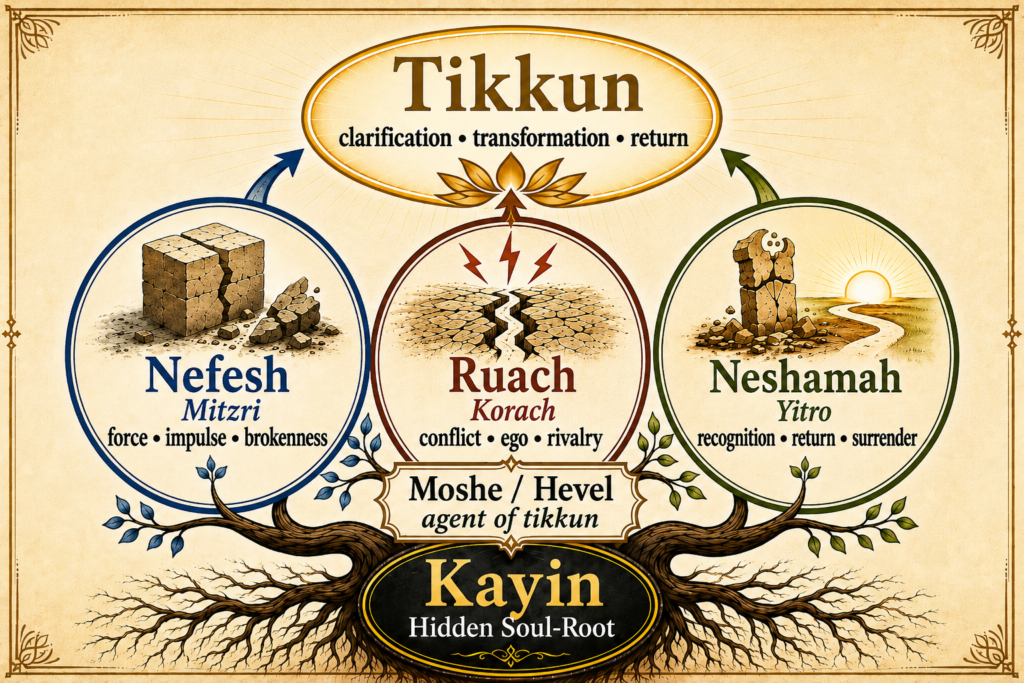
Sha'ar ha-Pesukim, one of the holy writings of the Arizal as recorded by R' Chaim Vital, often looks beneath the surface of the Torah's stories to reveal the journey of the hidden soul-roots moving within them. In his teaching on Kayin, the Arizal shows that Kayin's root reappeared in three figures from Moshe's generation: the Mitzri, Korach, and Yitro – three very different people, each carrying a different part of that root, as Hashem guided it through judgment, confrontation, and ultimate tikkun.
We begin with Hevel and Kayin (Bereshit 4:8): וַיֹּאמֶר קַיִן אֶל־הֶבֶל אָחִיו וַיְהִי בִּהְיוֹתָם בַּשָּׂדֶה וַיָּקׇם קַיִן אֶל־הֶבֶל אָחִיו וַיַּהַרְגֵהוּ (And Kayin said to Hevel his brother, and it came to pass when they were in the field, and Kayin rose up against Hevel his brother, and he murdered him). What were they talking about that was so contentious? It is brought down in the Midrash (Bereshit Rabbah 22:7): אָמַר רַבִּי הוּנָא תְּאוֹמָה יְתֵרָה נוֹלְדָה עִם הֶבֶל, זֶה אוֹמֵר אֲנִי נוֹטְלָהּ שֶׁאֲנִי בְּכוֹר, וְזֶה אוֹמֵר אֲנִי נוֹטְלָהּ שֶׁנּוֹלְדָה עִמִּי, וּמִתּוֹךְ כָּךְ וַיָּקָם קַיִן (R' Huna said, An extra twin sister was born with Hevel. One said, I will take her because I am the firstborn. And the other said, I will take her because she was born with me. As a result, 'And Kayin rose up').
Later, in response to Kayin's concern that everyone would want to take his life, Ha-Kadosh, baruch Hu, tells him (Bereshit 4:15): וַיֹּאמֶר לוֹ יְיָ לָכֵן כׇּל־הֹרֵג קַיִן שִׁבְעָתַיִם יֻקָּם וַיָּשֶׂם יְיָ לְקַיִן אוֹת לְבִלְתִּי הַכּוֹת־אֹתוֹ כׇּל־מֹצְאוֹ (And Hashem said to him, Therefore, whoever kills Kayin will be avenged sevenfold, and Hashem put a sign on Kayin lest any finding him should strike him). The word יֻקָּם is usually read in the sense of vengeance. But the Arizal sees in it a deeper hint to קִימָה [kimah] – rising, standing, and restoration. In other words, hidden inside the decree against Kayin is also the promise that he would one day rise toward his tikkun. R' Chaim Vital writes in Sha'ar ha-Pesukim that Kayin would have three primary reincarnations [gilgulim] to complete his tikkun (Bereshit, Siman 4): והם ר"ת יק"ם, שהוא חסר ו', והם י"תרו ק"ין מ"צרי, גם דע, כי ר"ת יק"ם, י"תרו, ק"רח, מ"צרי. כי גם קרח היה משרש גלגול נשמת קין, ולכן נתקנא במשה שהוא הבל כנודע (The letters of יֻקַּם – spelled deficiently in the pasuk without the ו – are an acronym for Yitro, Kayin, and the Mitzri, but also know that they are an acronym for Yitro, Korach, and the Mitzri. For Korach, also, was from the root of the reincarnated soul of Kayin; and therefore, he became jealous of Moshe, who was Hevel, as is known). So the encounter between Korach and Moshe is a replay, an opportunity provided by Hashem, to fix the damage created in the world through the encounter between the brothers Hevel and Kayin. At a soul-root level, Moshe and Korach were brothers, and this is why they needed to encounter each other in order for Moshe, i.e., Hevel, to help bring about a tikkun for Korach, i.e. Kayin.
But that's only part of the picture. If Yitro, Korach, and the Mitzri were all rooted in Kayin, how could all three appear in the same generation? The Arizal explains that Kayin's soul-root divided across three levels: his fallen nefesh appeared in the Mitzri, his ruach in Korach, and his neshamah in Yitro. Moshe's role was to interact with these three people in such a way as to bring each aspect of Kayin's soul to its tikkun.
The Mitzri whom Moshe killed was, according to the Midrash (Shemot Rabbah 1:28), a Mitzri taskmaster who violated Shelomit bat Divri by deceiving her, then beat her husband when her husband realized what had happened. This is what Moshe saw when the Torah says that he saw a Mitzri striking a Hebrew man – not only the beating in the field, but the earlier violation in the house (Shemot 2:11-12).
Clearly, the nefesh level of the soul is the focus here, and we can see the parallel between Kayin's lusting after Hevel's sister and the Mitzri lusting after the Jewish man's wife. So why did Moshe kill him? Was it merely justice in the narrow sense of the term? The Arizal teaches: ולכן לא הרגו בחרב, כי אם בשם המפורש כנודע, והכוונה היתה, לבררו מן הרע, ולהעלותו אל הקדושה על ידי שם בן מ"ב, שאין דבר מתברר ועולה למעלה, אלא בכח שם בן מ"ב (Therefore, he did not kill him with a sword, but rather with the Explicit Name, as is known; and the intention was to separate him from the evil and raise him up to kedushah through the Forty-Two-Letter Name, for nothing is purified and raised up except through the power of the Forty-Two-Letter Name). So Moshe, seeing the essence of the Mitzri's soul-root, acted deliberately to bring the nefesh level of Kayin's soul to its tikkun.
On that very day, something extraordinary happened: כי כאשר הרג את המצרי ותקן את נפש הרע של קין, אז תכף נדבקה ונכנסה ביתרו, שהיה כומר לע"ז, ונתגייר וכפר בע"ז, ובו ביום ברח משה מפני פרעה והלך למדין ומצא ליתרו שכפר בע"ז, ונתגייר ביום שהמית הוא את המצרי, ואז התחיל קין לתקן. הרי כי הריגת המצרי, וכפירת יתרו בע"ז הכל ענין אחד, והכל היה ע"י משה (For when he killed the Mitzri and rectified the evil nefesh of Kayin, then immediately it attached itself to and entered Yitro, who had been a priest of avodah zarah, and he converted and rejected avodah zarah. On that very day, Moshe fled from Pharaoh and went to Midian, and he found Yitro who had rejected avodah zarah and converted on the day that Moshe killed the Mitzri, and then Kayin began to be rectified. Thus, the killing of the Mitzri and Yitro's rejection of avodah zarah are all one matter, and everything was through Moshe). But there is more to Yitro's tikkun than just rejecting avodah zarah. R' Chaim Vital explains: כי אז החזיר את התאומה היתירה שלקח מהבל אחיו, ונתנה למשה, שהוא הבל, ונתן לו צפורה בתו, שהיא התאומה היתירה ההיא (For then he returned the extra twin sister whom he had taken from Hevel his brother, and gave her to Moshe, who is Hevel, and he gave him Tzipporah his daughter, who was that very extra twin sister). Whereas Kayin killed Hevel to take his sister, Yitro repairs the damage by giving Tzipporah to Moshe. The taking becomes giving, rivalry becomes surrender, and the same soul-root that had appeared as Hevel's sister returns as Tzipporah.
Let's move on to Korach. It is brought down in the Gemara (Sanhedrin 109b): ״וַיִּקַּח קֹרַח״ – אָמַר רֵישׁ לָקִישׁ שֶׁלָּקַח מִקָּח רַע לְעַצְמו ("And Korach took" [Bemidbar 16:1] – Reish Lakish said that he took a bad acquisition for himself). What was the מִקָּח רַע, the bad acquisition, that he took for himself? Rashi says: התחיל בקטטה (He initiated a quarrel). Without getting into the details of how the Arizal derived it, R' Vital summarizes: והנה כאשר עלה בדעתו של קרח, לחלוק עם משה, נתנוצצה בו רוחו של קין … להודיע כי לקח רוח קין … וזהו פירוש מ"ש רז"ל לקח מקח רע לעצמו, שהוא הרוח של קין, מצד הרע שבו (When Korach decided to oppose Moshe, the ruach of Kayin sparkled within him … to make known that he took the ruach of Kayin … And this is the explanation of Chazal's statement that Korach 'took a bad acquisition for himself,' that he took the ruach of Kayin from its evil side). The 'bad acquisition' was the ruach of Kayin. That's very specific, and really helps us to understand the precision of Reish Lakish's words. The very same attitude that Kayin expressed toward Hevel, Korach expressed toward Moshe, who, as we have seen, was his brother at the soul-root level. When Kayin's korban wasn't accepted, and he was rebuked by Hashem, we could summarize his attitude as, "If I cannot receive acceptance from Hashem on my terms, I will oppose the one whose acceptance exposes my failure." With Korach, it would be, "If I am not given the place I believe I deserve, I will declare the whole structure illegitimate." In both cases, when reality did not confirm their desired place, they did not submit to correction. They turned against the person whose very existence revealed that Hashem had chosen otherwise.
So how did Korach receive his tikkun? Not like the Mitzri, whose fallen nefesh was clarified and elevated, and not like Yitro, whose tikkun came through recognition, teshuvah, and conversion. Korach's tikkun came through a terrifying middah k'neged middah. With Kayin, the earth opened its mouth to receive his brother's blood (Bereshit 4:11). Similarly, with Korach, the earth opened its mouth to swallow him up (Bemidbar 16:29). The parallel is striking: the same earth that once received Hevel's blood now opened again to swallow Korach, who had taken Kayin's evil ruach unto himself.
But this is not a story about punishment. It is a story about how Hashem guides hidden soul-roots toward their tikkun in ways we would never understand on our own. From below, these look like separate events: a killing in Egypt, a conversion in Midian, and a rebellion in the wilderness. From above, they are connected through the Tzaddik, Moshe Rabbeinu, a gilgul of Hevel, as Hashem guides the scattered soul-root of Kayin toward its tikkun.
That is why we should be slow to assume we understand our own lives. We do not always know why we struggle where we struggle, why certain people challenge us so deeply, or why Hashem places us in situations that feel confusing or unfair. We experience these things as personality, circumstance, or conflict, but Hashem sees the deeper root.
Do you really know who you are? Probably not. But Hashem does. And sometimes the most confusing parts of our lives are the very places where He is bringing the hidden roots of our soul toward their tikkun.