Library of Weekly Reports

Divrei Torah Rooted in Breslov Chassidut

Collected Archive of Shoemaker Reports

The Shoemaker Report is Rav Hoshea’s weekly Torah publication. Its focus is on internalizing and living Torah from the heart, not only from the head. The divrei Torah often take the parashah of the week as their point of entry and address central questions of inner avodah — including teshuvahprayer (tefillah)emunah, bitachon, and related areas of spiritual and personal refinement.

The writing assumes seriousness from the reader and speaks from within Torah life, with meaning emerging organically from honest analysis of our holy Torah and the words of Chazal, rather than from short-lived inspiration or simplified conclusions.

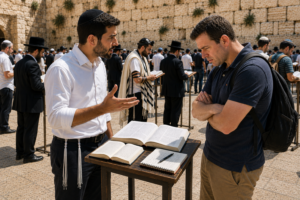
Jewish man and missionary at the kotel, missionary looking dejected because he didn't win his argument

Does Our Torah Predict Their Messiah?

Missionaries often cite Devarim 18:15 as proof that Moshe predicted their messiah as a unique future “prophet like me.” But is that really what the Torah says? When the pasuk is restored to its proper context and examined through the explanations of the Sifrei, Rashi, the Gur Aryeh, and the Rambam, the missionary reading begins to collapse. Rather than predicting a new religious figure who would replace the Torah of Moshe, the passage describes the continuing institution of prophecy within Yisrael — rooted in that Torah and bound by it.

Read More →
A Jewish man reading Likutei Halachot saying to himself, "I have to forget in order to remember? Huh?"

The Memory of Forgetfulness

Why does the Torah forbid cutting oneself or tearing out hair for the dead? Drawing on Likutei Halachot, this article explores R' Natan's paradox that true memory depends upon forgetting. It explains how Jewish mourning directs grief away from despair and toward emunah, Olam ha-Ba, resurrection, and the eternal bond between the soul and Hashem.

Read More →
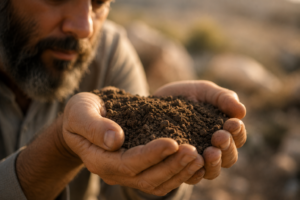
A man holding dirt, symbolizing true humility

The Two Kinds of Dirt

What is the difference between true humility and the kind of humility that leaves a person discouraged, passive, and unable to act? Drawing on the Gemara, Rashi, and Breslov Torah, this article explores the two spiritual meanings of dirt: the holy humility connected to techiyat ha-meitim, tefillin, and Eretz Yisrael, and the fallen humility of sadness and laziness upon which the Serpent feeds.

Read More →

Turning Sorrow and Sighing into Simchah

The lineage of Mashiach passes through the unlikely nations of Moav and Ammon, through Rut, Na'amah, and David ha-Melech. This essay explores why geulah must emerge from such spiritually compromised beginnings, and how Sefer Tehillim, the ten types of niggun, and the avodah of David transform yagon and anachah – sorrow and sighing – into sasson, simchah, prayer, song, and new life.

Read More →

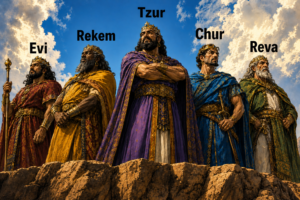
The Five Klipot of Midian

The Aderet Eliyahu reveals that the Five Kings of Midian were not merely historical enemies, but five klipot of the Sitra Achra. Evi, Rekem, Tzur, Chur, and Reva each represent a different spiritual vulnerability through which kedushah can be exploited, corrupted, hardened, or separated from life. Learn what this 'ancient history' has to do with you.

Read More →

Reuven, the Firstborn of Yisrael

If Ya'akov intended Rachel but was with Leah, did that spiritually damage the soul of Reuven in some mystical way and remove him from his firstborn status? In the language of Chazal, was Reuven a "ben temurah"? This essay explores the mystery of Ya'akov, Leah, Rachel, Yosef, and Reuven, showing how Hashem's truth is exact: the firstborn blessing returned to Yosef, but Reuven was not rejected.

Read More →

When the Yetzer ha-Ra Wears a Black Hat

What is the deeper connection between Balak and Bila'am? R’ Natan reveals that Balak represents open evil, while Bila'am represents something far more dangerous: corruption dressed in the language of truth, Torah, and fear of Heaven. This teaching explores how the Yetzer ha-Ra can disguise itself as religious sincerity, turn machloket into a mitzvah, and lead a person away from real kedushah while claiming to defend it.

Read More →

The Holy Chutzpah of the Worm

What is the spiritual meaning of Parah Adumah? The cedar, hyssop, and crimson wool reveal how the red heifer teaches humility, holy boldness, attachment to the Tzaddik, and the power of Torah and tefillah to bring the highest divine light even to the lowest Jew.

Read More →

Why We Cannot Understand Our Own Lives

Do we really understand our own lives? Through the Arizal’s teaching on Kayin, Moshe, Yitro, Korach, and the Mitzri, this essay explores hidden soul-roots, gilgulim, and how Hashem guides even confusing struggles toward tikkun.

Read More →

A Land That Consumes Its Inhabitants

Why did the meraglim speak lashon ha-ra against Eretz Yisrael? We explore the deeper root of their sin: the refusal to descend from lofty da'at into humble emunah, where physical mitzvot transform the lower world and reveal Hashem's presence in the Land.

Read More →

The Flowers of the Menorah

The menorah is not merely a vessel of light, but a map of the human heart. Its flowers reveal the mystery of fallen love: even desire that has descended into broken places still carries hidden sparks of kedushah, waiting to be elevated by reconnecting longing to its true source in Hashem.

Read More →

Yashfeh: The Stone of Binyamin

Why did Binyamin merit the Beit ha-Mikdash in his portion? This essay explores the hidden greatness of Binyamin through the stone of yashfeh, the power of silence, and his response to humiliation and suffering. Drawing from Midrash, Gemara, and Breslov teachings, it uncovers how restraint, dignity, and quiet endurance became the vessel for the revelation of the Shechinah.

Read More →