A Chassidic Vort on the Korban Olah
Torah study is not defined only by what a person learns, but by how he learns it. True limud Torah rests on three foundations: it must burn with an inner fire, it must be directed toward Hashem, and it must remain inward and genuine rather than something done for appearance. These are not three separate paths, but three dimensions of a single avodah. The Torah itself alludes to this structure in its description of the olah – and the Chassidic masters read this pasuk not only as a law of korbanot, but as a map of how Torah must be learned.
Parashat Tzav opens with Hashem speaking to Moshe (Vayikra 6:2): צַו אֶת־אַהֲרֹן וְאֶת־בָּנָיו לֵאמֹר זֹאת תּוֹרַת הָעֹלָה הִוא הָעֹלָה עַל מוֹקְדָה עַל־הַמִּזְבֵּחַ כׇּל־הַלַּיְלָה עַד־הַבֹּקֶר וְאֵשׁ הַמִּזְבֵּחַ תּוּקַד בּוֹ (Command Aharon and his sons, saying: This is the Torah of the olah, it is the olah on the burning place on the altar all the night until the morning, and the fire of the altar burns in it). At first glance, the pasuk appears to describe only the mechanics of the offering. But upon closer reading, one quickly recognizes that the wording is peculiar in a number of ways, and it is this peculiarity that reveals a threefold structure that defines the inner nature of Torah itself.
R' Tzvi Elimelech of Dinov, a Chassidic Rebbe and posek, known primarily for his work Agra d'Kallah, asks the question: איזה לימוד תורה היא עולה לי"י לריח ניחוח (Which limud Torah is an olah to Hashem, for a pleasing aroma)? He answers by seeing hints [רְמָזִים, remazim] in our pasuk. First, he makes two interpretive moves that redefine our understanding of the pasuk: תורת doesn't just mean 'the law of,' and העולה doesn't just refer to the offering. He sees זֹאת תּוֹרַת הָעֹלָה (This is the Torah of the olah) as hinting at זא"ת היא התורה אשר תעלה לי"י (This is the Torah that will ascend to Hashem). Second, he sees הִוא הָעֹלָה עַל מוֹקְדָה (This is the olah upon the burning place) as the answer to that declaration: אשר עולה בהתלהבות הלב באהבתו ואש תוקד בקרבו מאהבת הש"י (That rises with the fervor of the heart in love of Him, and a fire burns within him from love of Hashem, may He be blessed).
He continues by explaining the remez in the olah burning כׇּל־הַלַּיְלָה עַד־הַבֹּקֶר (all the night until the morning): אפילו כל ימי הגלות שנקרא לילה, עד זמן הגאולה שנקרא בקר (Even all the days of the Exile, which is called 'night', until the time of the Redemption, which is called 'morning'). Even though the Jewish People have gone through so much over the years, it does not give us reason to let up on the fire that should be burning in our hearts, indicative of our love for Hashem as expressed by our limud Torah. And then he makes a truly remarkable chiddush when explaining a deeper meaning of וְאֵשׁ הַמִּזְבֵּחַ תּוּקַד בּו (and the fire of the mizbei'ach burns in it). Focusing on the unusual word בּוֹ at the end of the pasuk – which literally means 'in him' or 'in it' – as opposed to what we might have expected the pasuk to say, i.e. עָלָיו (on it), he writes the following: היינו על ידי לימוד תורה תוקד בו התלהבות השכינה (That is, through limud Torah, there will burn within him the fervor of the Shechinah). In other words, the burning enthusiasm and fervor [הִתְלַהֲבוּת, hitlahavut] that he brings to his limud Torah, i.e. that he offers up to Hashem – to the Shechinah, so to speak – 'returns' to him, so to speak, and burns in him, no longer by his own efforts, but directly from Hashem.
This can be understood in the language of sod as the transition from an awakening from below [אִתְעָרוּתָא דִּלְתַתָּא, itaruta diltata] to an awakening from above [אִתְעָרוּתָא דִּלְעֵילָא, itaruta dileila], from female waters [מַיִין נוּקְבִין, mayin nukvin] to male waters [מַיִין דּוּכְרִין, mayin duchrin]. At the outset, the fire is his – his hitlahavut of the heart, his itaruta diltata, his mayin nukvin rising upward as an offering. But once that awakening happens, it elicits a corresponding itaruta dileila: a drawing down of shefa known as mayin duchrin until the original human fire is no longer the sole or primary fire. This is the meaning of תּוּקַד בּוֹ – that the fire now burns in him: not merely that he burns toward Hashem, but that the fire of the Shechinah rests within him and burns of its own. The initial ascent of the female waters awakens the descent of the male waters, and the avodah shifts from human exertion to a state in which the Shechinah itself sustains the flame, even in moments when limud Torah must, by necessity, be interrupted.
Now that the fire has been kindled and is burning, the question is no longer whether it burns, but where it is directed. R' Elimelech of Lizhensk, one of the central early leaders of Chassidut and a primary disciple of R' Dov Ber of Mezeritch, in his foundational work, Noam Elimelech, addresses this point: that even a true fire must be for Hashem, and not, chas v'shalom, for one's own kavod.
He begins by reminding his readers that, at the level of sod, the Shechinah is known as זֹאת [zot, this (feminine)], which enables him to see a different remez in the words זֹאת תּוֹרַת הָעֹלָה (This is the Torah of the olah): ר"ל אם לימוד התורה היא לשם זאת, דהיינו לשמה, להעלות נחת רוח ליוצרו, "העולה" פירוש התורה הזאת עולה לפניו ית"ש, אבל מי שאינו לומד לשמה ולימודו הוא מצד השמאל, ולזה רמז "הִיא" לשון נוקבא שהוא צד שמאל (That is to say, if one's limud Torah is for the sake of this [l'shem Zot], i.e. for its own sake, to elevate satisfaction to his Creator – then 'the olah', meaning, this Torah rises before Him, may He be blessed. But one who does not learn for its own sake, and whose learning is from the left side, this is alluded to in 'הִיא', a feminine expression, which corresponds to the left side).
Put simply, when one's limud Torah is l'shem Zot, when Torah is learned for the sake of the Shechinah, then it rises as a pleasing aroma [רוּחַ נִיחוֹחַ,ruach nicho'ach] and thus gives Hashem, so to speak, נַחַת רוּחַ [nachat ruach, satisfaction]. However, when one's limud Torah is not l'shem Zot, chas v'shalom, then his offering undergoes a different process. His olah, i.e. the Torah that he has learned, must go up עַל מוֹקְדָה עַל־הַמִּזְבֵּחַ (on the burning place on the mizbei'ach). What does that mean? It means התורה הזאת צריכה לבא על מוקדה בגיהנם, וענוש יענש ויוצרף בצרוף אש של גיהנם (This Torah needs to come upon the burning place in Gehinnom, and he shall surely be punished and refined in the refining fire of Gehinnom). Ouch! That's sharp. And why does the pasuk specifically tell us that the burning place is on the mizbei'ach? Don't we already know that? According to the Noam Elimelech: התורה שהיה ראוי להיות כפרה כמו מזבח, דבזמן שבית המקדש קיים הקרבנות מכפרים, ועכשיו התורה מכפרת (The Torah is fit to be an atonement, like the mizbei'ach, for when the Beit Ha-Mikdash stood, the offerings atoned, but now the Torah atones).
But don't Chazal tell us that it's still good to learn lo lishmah even if we can't learn lishmah? How does the Noam Elimelech address that objection? He writes: כי חז"ל התירו שלא לשמה שמתוך שלא לשמה יבא לידי לשמה, אבל אם לומד כל ימיו שלא לשמה בודאי ענוש יענש בגיהנם (For Chazal permitted learning lo lishmah, since from lo lishmah one will come to lishmah; but if one learns all his days lo lishmah, he will most certainly, surely be punished in Gehinnom). So there's not a lot of wiggle room here, is there? True, most of our learning is probably somewhere in the middle between total lo lishmah at one end of the spectrum and complete lishmah at the other end; we should know that although lo lishmah may be a valid entry point, it must be temporary. Limud Torah is not neutral. If it is truly lishmah, it rises and atones; if not, to the degree that it is not, that very Torah becomes the fire that judges us.
We have now seen two of the dimensions – hitlahavut and lishmah. What's the third and final dimension?
The Ma'ayanah Shel Torah, a compilation of vortlach from many gedolei Yisrael, including Chassidic masters, brings down a fascinating vort in the name of R' Menachem Mendel of Kotzk, known affectionately as the Kotzker Rebbe, that focuses on something in the pasuk that we have so far ignored. In the Sefer Torah, the word מוֹקְדָה (burning place) is written with a small מ, what is known as מ׳ זעירא [mem ze'ira]. He writes: האות "מ" הזעירא ב"מוקדה" באה לרמז, כי ההתלהבות והלהט של אדם-מישראל לתורה וליהדות אינם צריכים להיות בולטים לכל עין, כי אם חבויים בלבו פנימה (The mem ze'ira in מוֹקְדָה [burning place] comes to hint that the hitlahavut and passion of a Jewish man for Torah and for Yiddishkeit, should not stick out to every eye, but rather be hidden inwardly in his heart). So even though the fire on the mizbei'ach must burn constantly, the Torah makes the מ small to suggest that the true fire of our avodah in limud Torah must be inward. The external display should remain modest; the inner flame is what must be intense. Authentic, genuine – not for show. A real fire of hitlahavut lishmah doesn't advertise itself. It simply burns 24/7 – even all night until the morning.
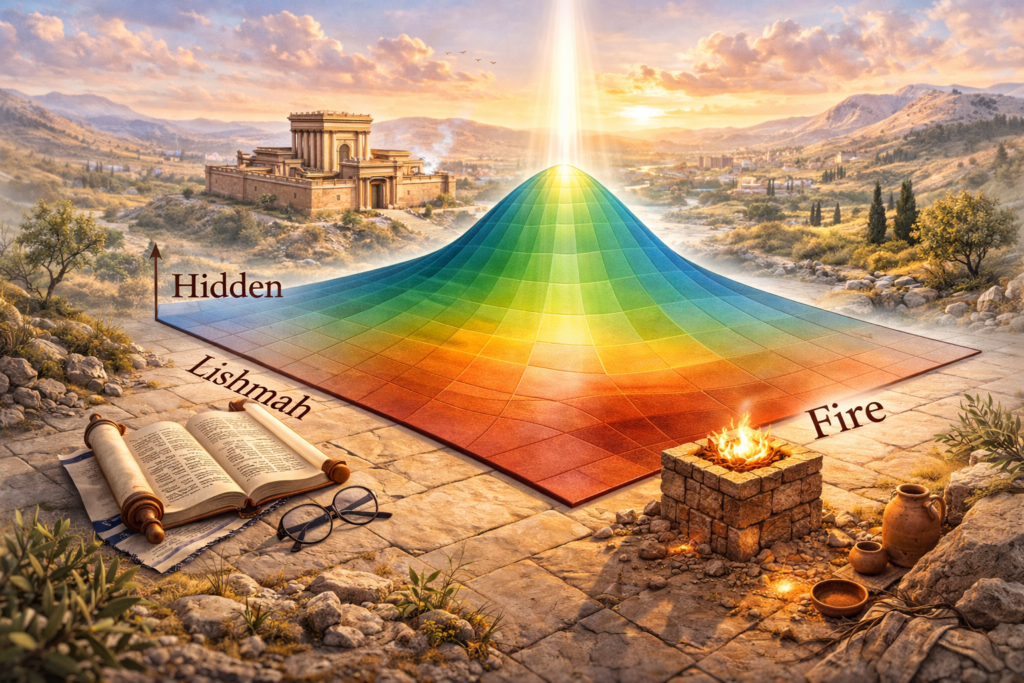
In summary, limud Torah must be conducted with fiery passion, directed toward Hashem, and internal. The Agra d'Kallah guards against limud without any fire at all. The Noam Elimelech guards against limud directed at one's own honor. And the Kotzker Rebbe guards against limud that is on display for others to see.
For limud Torah to be truly an olah consumed on the burning place, on the mizbei'ach, all night until the morning, three conditions must be met: it must burn with fire, the fire must be for Hashem, and the fire must be inward. Therefore, ask yourself: Am I learning with fire? To whom is my learning directed? And is my learning sincere and unpretentious?