Library of Weekly Reports

Divrei Torah Rooted in Breslov Chassidut

Collected Archive of Shoemaker Reports

The Shoemaker Report is Rav Hoshea’s weekly Torah publication. Its focus is on internalizing and living Torah from the heart, not only from the head. The divrei Torah often take the parashah of the week as their point of entry and address central questions of inner avodah — including teshuvahprayer (tefillah)emunah, bitachon, and related areas of spiritual and personal refinement.

The writing assumes seriousness from the reader and speaks from within Torah life, with meaning emerging organically from honest analysis of our holy Torah and the words of Chazal, rather than from short-lived inspiration or simplified conclusions.

Taking Torah in the Age of the Internet

In Parashat Terumah, “וְיִקְחוּ־לִי” reveals that Torah is not information but hamshachah – drawing the Shechinah into the mind. Based on Likutei Moharan, Tinyana 60, this essay explores chiddushei Torah in the age of the internet: how online Torah can elevate a prepared vessel – or entrap an unready one – and why both teacher and listener must serve as the filter.

Read More →

Don't Read Life as Walking – Read It as Standing

At the end of Shas (Niddah 73a), Chazal overturn how we read life: not halichah – constant striving and movement – but halachah – structure, inner standing, and already-lived meaning. A ben Olam ha-Ba is not promised a future reward, but embodies Olam ha-Ba now through humility, completion, and a life that can stand on its own.

Read More →

How Yitro Heard

Why do spiritual breakthroughs so often fail to change us? Through Yitro’s hearing, kriat Yam Suf, and the battle with Amalek, this Shoemaker Report explores why intensity alone doesn’t transform — and how restraint, not inspiration, allows real emunah to take root.

Read More →

When History Holds Its Breath

There are moments when history seems to hold its breath. Redemption unfolds in two stages – leaving and entering. The space between them is unstable, but not broken. That instability is called ra‘ad: the tremor that appears when inner truth begins to rule outer life.

Read More →

Tefillin and the Elevation of Yirah

In Parashat Bo, the mitzvah of tefillin reveals a deep map of inner avodah. Drawing on Likutei Moharan 15, this essay explores how fallen fear (yirah) is elevated through self-judgment and humility into da’at, transforming fear into awe and opening the path to the hidden light of the Torah.

Read More →

When Redemption Cannot Be Heard

At the end of Parashat Shemot, B’nei Yisrael believe Moshe’s promise of redemption. But after Pharaoh intensifies the bondage, they can no longer hear it. Not rebellion, but kotzer ruach – a collapse of human capacity under crushing pain. The Torah records this without blame, and redemption moves forward anyway.

Read More →

Rachel on the Road, Leah in the Cave

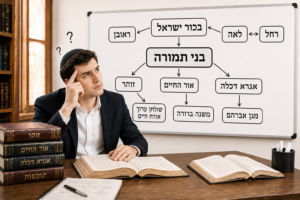
A profound reading of Parashat Vayechi exploring why Ya'akov buried Rachel on the road and Leah in Ma'arat ha-Machpelah. This report traces how Ya'akov places truth, love, and destiny at the end of life – revealing exile, permanence, and where each truth belongs.

Read More →

Why Nothing Changes

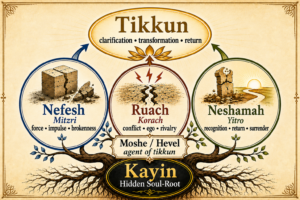
You pray, fast, and struggle to change, yet nothing seems to last. The effort feels sincere, even heroic, but the same patterns return. The failure is not moral weakness – it is structural. Self-reliance itself becomes the barrier to true repair.

Read More →

Learning to See Leah

He conquered Lavan and Esav, but the final transformation came only when Ya'akov saw Leah for who she truly was. Becoming Yisrael meant learning to recognize the greatness that had been beside him all along.

Read More →

Rachel's Silence

Rachel’s silence in Vayeitzei hides one of the Torah’s most painful truths. For seven years she watched Leah receive the love, gifts, and destiny meant for her – and said nothing, choosing compassion over vindication. Her quiet sacrifice reshapes our understanding of the entire parashah.

Read More →

Engineered Descent

Why does Hashem lift us only to send us down again? Rebbe Nachman teaches that ascent is just the breath before a descent. Through Parashat Toledot, we see how even our descents—whether struggles or missions—become pathways to deeper light, strength, and true tikkun.

Read More →

The Anatomy of Modesty

The act of Shem and Yefet covering their father reveals a map of modesty: body, will, and soul aligning to guard the tzelem Elokim. From instinctive awe to conscious mitzvah to divine stillness, the Torah shows how true tzniut radiates holiness from within.

Read More →