How the Five Kings Reveal the Sitra Achra's Hidden Ways of Exploiting Kedushah
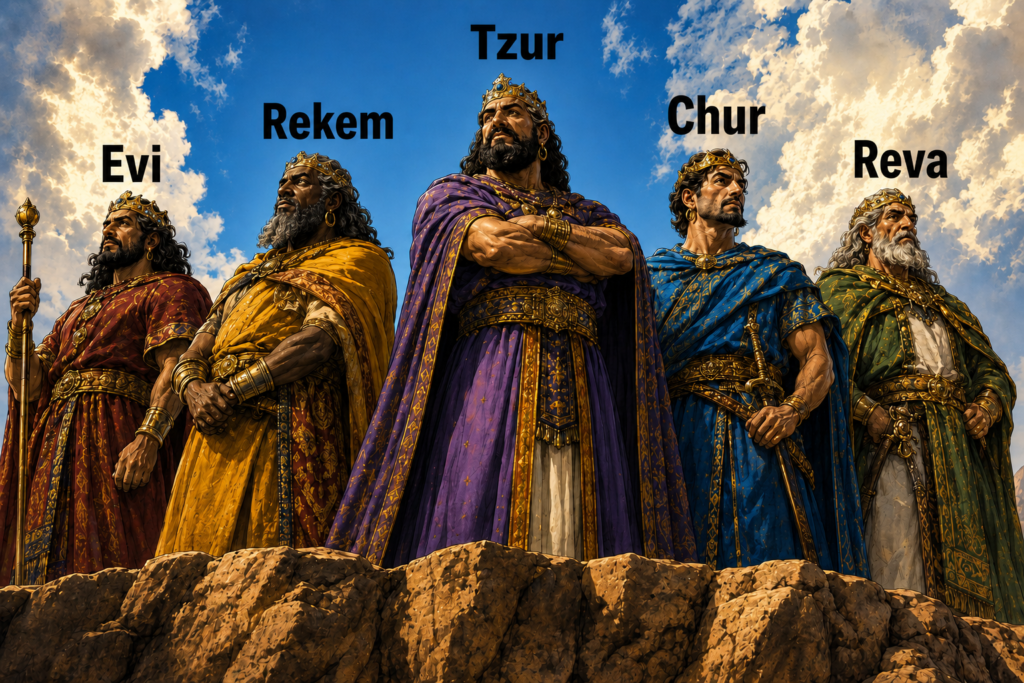
After the Torah records the war against Midian, it states (Bemidbar 31:8): וְאֶת־מַלְכֵי מִדְיָן הָרְגוּ עַל־חַלְלֵיהֶם אֶת־אֱוִי וְאֶת־רֶקֶם וְאֶת־צוּר וְאֶת־חוּר וְאֶת־רֶבַע חֲמֵשֶׁת מַלְכֵי מִדְיָן וְאֵת בִּלְעָם בֶּן־בְּעוֹר הָרְגוּ בֶּחָרֶב׃ (And they killed the kings of Midian, along with their slain: Evi, Rekem, Tzur, Chur, and Reva, the five kings of Midian; and Bila'am ben Beor they killed by the sword). The pasuk is striking. The Torah could simply have said that the five kings of Midian were killed. Instead, it pauses to name each one individually. Yet surprisingly, almost none of the classical commentators explain why these names needed to be recorded at all.
The notable exception is the Aderet Eliyahu, a work of R' Yosef Chaim of Baghdad, the Ben Ish Chai, who reads the five names not merely as historical identifications, but as allusions to five channels through which Midian drew spiritual vitality from damaged kedushah. He begins not with the names themselves, but with a remez in the words עַל־חַלְלֵיהֶם, typically understood as "along with their slain" or "beside the rest of their slain." The Aderet Eliyahu reads the word חַלְלֵיהֶם as related to חִילּוּל [chillul, desecration] and writes: לְשׁוֹן חִילּוּל, רוֹצֶה לוֹמַר בִּשְׁבִיל חִילּוּלָם שֶׁחִילְּלוּ הַקְּדוּשָּׁה בִּינִיקָתָם מִמֶּנָּה, חַס וְשָׁלוֹם, כִּי אֵין קִיּוּם לְסִטְרָא אָחֳרָא כִּי אִם בַּקְּדוּשָּׁה (It is an expression of desecration. In other words, because they desecrated the kedushah by nursing from it, chas v'shalom, because the Sitra Achra has no existence except through kedushah). Before explaining the five names, the Aderet Eliyahu first defines the nature of the battle. Yisrael was not merely killing five Midianite kings; they were cutting off the Sitra Achra's desecrating hold on kedushah. This opening remez sets up the framework for everything that follows. Each king represents a different breach through which the Sitra Achra nourishes itself from kedushah – five kings, five separate channels of exploitation.
The Aderet Eliyahu proceeds through the five kings in the order in which they appear in the pasuk. He begins with Evi, the most difficult of the five for us to grasp because its meaning is rooted in a highly kabbalistic reading of Adam and Hevel's primordial defects. In short, based on a teaching in the Tikkunei Zohar 69, the name אֱוִי alludes to the letters או"י: Hevel blemished the א׳ and י׳ of the Name אהי״ה, while Adam Ha-Rishon blemished the ו׳ and י׳ of the Name הוי״ה. Taken together, these damaged "letters" form the word או״י, which can also be read as אוֹי – Woe! In other words, Evi represents the ancient cry of אוֹי rooted in the primordial defects of Adam and Hevel. Their sins damaged the proper flow of Divine light from its hidden source into thought and from thought into lived reality. When that flow was blocked, a vulnerable opening was left in kedushah. Evi had the ability to feed from that opening – the gap between a high Divine light and the vessel that should have received it.
In Adam's case, the opening was the gap between holy thought and lived reality. A Jew can possess holy thoughts, da'at, and awareness, yet still remain divided between what he knows and how he feels or lives. Evi, as a king of Midian, was able to feed from that gap, redirecting holy energy into confusion, pride, fantasy, argument, or lust. In Hevel's case, the opening was different: sincere purity without sufficient vessels. A Jew can possess longing, refinement, and genuine spiritual sensitivity, yet still remain exposed because the kedushah is not fully guarded or contained. Remember, Hevel's korban was accepted, so this is not the weakness of a "sinner" in the classical sense, but of someone spiritually elevated and still vulnerable. Evi could exploit that exposure through seduction, admiration, emotional confusion, false compassion, spiritual flattery, or the feeling that something was holy when it was not. In short, Evi was dangerous because he embodied the power to exploit holy light that was real, but not yet stable, guarded, or fully grounded.
Rekem posed a completely different threat. The Aderet Eliyahu writes: וְאֶת רק"ם רָמַז לש"ם נִיצוֹצוֹת, שֶׁהֵם רפ"ח וב"ן, שֶׁנִּתְעָרֵב בָּהֶם סִיגִים, וּצְרִיכִים תִּיקּוּן, וְלָכֵן כָּל עוֹד שֶׁלֹּא נִתְקְנוּ וְעָלוּ כּוּלָּם, יֵשׁ לָהֶם כֹּחַ לִינֹק, חַס וְשָׁלוֹם (And Rekem [gematria of 340] alludes to the 340 sparks, which are רפ"ח [288] and ב"ן [52], into which dross is mixed, and they require tikkun. And therefore, as long as they have not all been rectified and elevated, the Sitra Achra has the power to nurse from them, chas v'shalom). In the kabbalah of the Arizal, 288 refers to the sparks of kedushah that descended and became mixed with the lower worlds – an event known as the "breaking of the vessels" – and 52 refers to the Divine Name ב"ן, associated with the lower world, the World of Asiyah. The total of 340 refers to the whole condition of fallen kedushah after the breaking of the vessels: sparks of kedushah mixed with impurities, inside the lower receiving realm, the World of Asiyah, all requiring clarification and elevation. This is interesting because the name רֶקֶם is related to the word רִקמָה, meaning embroidery or a woven pattern, i.e., something interlaced, entangled, or mixed together.
Whereas Evi exploited the primordial rupture in the high channels of light that Adam and Hevel failed to integrate and bring down properly, Rekem exploited the next stage: once there is a rupture, sparks of kedushah fall or become mixed with dross and impurities. The Sitra Achra can then receive vitality from those trapped sparks. Therefore, Rekem represents the power that feeds from kedushah after it has become mixed into the lower realm, hidden inside confusion, impurity, and broken vessels. A Jew confronting Rekem would not necessarily feel pulled toward something obviously empty. He may feel pulled toward something that contains a genuine point of life, beauty, insight, pleasure, mission, or emotional truth. The problem is that the genuine point is embedded inside a corrupted package, for example, a desire may contain a real spark of longing for connection but it could be mixed with forbidden attraction, anger may contain a real spark of justice but it could be mixed with ego or cruelty, or ambition may contain a real spark of a holy mission but it could be mixed with desire for kavod and control.
Tzur is easier to understand conceptually. The Aderet Eliyahu says: אֶת צוּ"ר רָמַז לִבְחִינַת שֵׁם אֱלֹקִים שֶׁהוּא דִּין, וְכָל עוֹד שֶׁלֹּא נִתְקַן וְנִתְמַתֵּק, אָז יֵשׁ לָהֶם כֹּחַ לִינֹק, חַס וְשָׁלוֹם (The name Tzur alludes to the aspect of the Name Elokim which is judgment [din], and as long as it hasn't been rectified and sweetened, then they have the power to nurse, chas v'shalom). How does this remez work? The name צוּר has the gematria of 296, and together with its 3 letters and the word itself, i.e., the kollel, the total is 300, which is the same as the Name אלקים when spelled out fully: אל״ף למ״ד ה״י יו״ד מ״ם. Tzur taps into unsweetened din plain and simple. Not din itself. Din is holy when it is in its proper place. Din indicates boundary, judgment, measure, consequence, discipline, separation, and accountability – and without din, nothing has form or structure. The world needs din, but it doesn't need unrectified or unsweetened din, for that kind of din is harsh and merciless. Yet, in its unmitigated state, the Sitra Achra can feed off it and gain ascendancy.
A Jew encountering Tzur would be vulnerable wherever his sense of truth, justice, discipline, fear of Heaven, or moral clarity becomes severe without rachamim. The danger is that a person may think, "Gevurah is holy. This is standing for truth. This is good." But that's a very dangerous position. If the din is not sweetened, it can become cruelty, accusation, despair, rigidity, anger, contempt, or even violence. We could see this in a person's guilt turning into self-hatred, awareness of one's own sins turning into despair, moral clarity turning into harsh judgment of others, discipline turning into rigidity or a lack of compassion, or a sense of justice turning into revenge. All of this, chas v'shalom, would be the klipah of Tzur.
Next is Chur. The gematria of חור is 214 and along with its 3 letters, the total comes to 217. This is the same as גבורה [gevurah] with the kollel [216 + 1 = 217]. Specifically, the Aderet Eliyahu teaches that as long as gevurot have not been sweetened with chassadim, then they become a source from which the Sitra Achra can nurse, chas v'shalom. In practical terms, Chur's ability to exploit is not harsh judgment like Tzur. It's more basic than that. It's tapping into a Jew's inner gevurah – which is kadosh. The person has a real fire burning inside, self-restraint, true discipline, zeal, proper boundaries – but without chassadim, that force becomes something the other side can feed from. Why? Because Hashem created the world with chesed, not just with gevurah, and gevurah on its own is a fire that consumes everything.
On the surface, Tzur and Chur sound similar. So what's the difference between them? Tzur manifests as judgment within a prosecuting structure; Chur manifests as the severity of raw force itself. Tzur weaponizes din against the Jew; Chur weaponizes the gevurah. Tzur is the courtroom that operates within the soul that says, "You are guilty. Your avodah is worthless. You are pathetic. You have no right to come close to Hashem." Chur says, "Be tough. Push. Insist. Do not yield. That is the path of true kedushah." Tzur is Balak; Chur is Kayin.
Finally, the fifth king, Reva: רֶבַע רָמַז לְהֵ"א הָאַחֲרוֹנָה שֶׁל הַשֵּׁם, שֶׁהוּא אוֹת רְבִיעִי, וְהִיא סוֹד שְׁכִינָה שֶׁהִיא בַּגָּלוּת, שֶׁהַחוֹטֵא גּוֹרֵם לְהַפְרִיד אוֹת הַהֵ"א מֵאוֹתִיּוֹת הַשֵּׁם (Reva alludes to the final ה in the Divine Name, which is the fourth letter [revi'i], and which is the secret of the Shechinah in galut, for the sinner causes the ה to be separated from the letters of the Name). Reva exploits disconnected kedushah – kedushah in exile, within our own lives. Practically speaking, we are dealing with the real danger of living in such a way that ordinary life – speech, action, food, home, relationships, sexuality, money – becomes detached from Hashem. We may still believe, learn, pray, or have good thoughts, but the final ה, the place where kedushah is supposed to permeate lived reality, is separated. Reva exploits not only disconnected kedushah, but disconnected living. A person may have higher awareness, but his malchut is in exile.
At this point, you might be wondering, What's the difference between Reva and Evi? The answer is that Evi would sense a Jew whose spiritual life is sincere but vulnerable. He has lofty thoughts, yearning, and purity, but not enough of a vessel to hold it. Reva would sense a Jew whose world may look religious, but whose speech, habits, relationships, business, sexuality, and overall daily conduct are not joined to Hashem.
What is the tikkun for this blemish? The Aderet Eliyahu says that the Shechinah is called teshuvah because teshuvah [תשובה] means, "Return [תשוב, tashuv] the letter ה!" Return the ה to its proper place in the Name Havayah. Become whole. When we do that, when we live kedushah, then we restore the Shechinah to Her place and bring about the end of galut, individually and collectively. This is real teshuvah. Until we do, the klipah of Reva feeds off this disconnect, and we stay in galut, chas v'shalom.
In conclusion, the Aderet Eliyahu writes that these five kings, these five klipot, are a weaponized system that work together to attack and defeat us, chas v'shalom: לָזֶה אָמַר חֲמֵשֶׁת מַלְכֵי מִדְיָן, חֲמֵשֶׁת מִלְּשׁוֹן זַיִּיוּן, כְּמוֹ: 'וּבְנֵי יִשְׂרָאֵל יָצְאוּ חֲמֻשִׁים מֵאֶרֶץ מִצְרָיִם', שֶׁהוּא רוֹצֶה לוֹמַר מְזוּיָּינִים (And for this reason it says, 'the five [chameshet] kings of Midian,' chameshet, from the language of being armed, like it says [Shemot 13:18], 'And B'nei Yisrael went out chamushim from the Land of Egypt', which means, that is to say 'armed'). The war against Midian was not merely a military war. It was a holy war against a weaponized system of the Sitra Achra designed to extract kedushah from five deep vulnerabilities within Klal Yisrael, both individually and collectively. By killing the five kings of Midian, Klal Yisrael cut off those channels: יִשְׂרָאֵל עַל יְדֵי שֶׁהֲרָגוּם בֵּירְרוּ אוֹתוֹ הַכֹּחַ מֵהֶם, וּבָטְלָה יְנִיקָתָם, וְנַעֲשָׂה בִּיטּוּל לְסִטְרָא אָחֳרָא בְּצַד מַה בָּזֶה (And Yisrael, by killing them, separated that power from them, and nullified their nursing, and a certain nullification of the Sitra Achra was accomplished).
Notice that the Aderet Eliyahu's wording is precise. The nullification was only בְּצַד מַה (in some measure). Those five kings were killed, but the vulnerabilities they exploited did not disappear. Evi, Rekem, Tzur, Chur, and Reva are no longer standing before us in Midianite robes, but their weapons remain. The war continues wherever kedushah is left unguarded, mixed with impurity, twisted into accusation, hardened into severity, or separated from the actual life a person lives. And the victory is the same for us as it was for our ancestors: reclaim the holy power from the Sitra Achra, return it to its source, and leave the enemy with nothing left to nurse from.