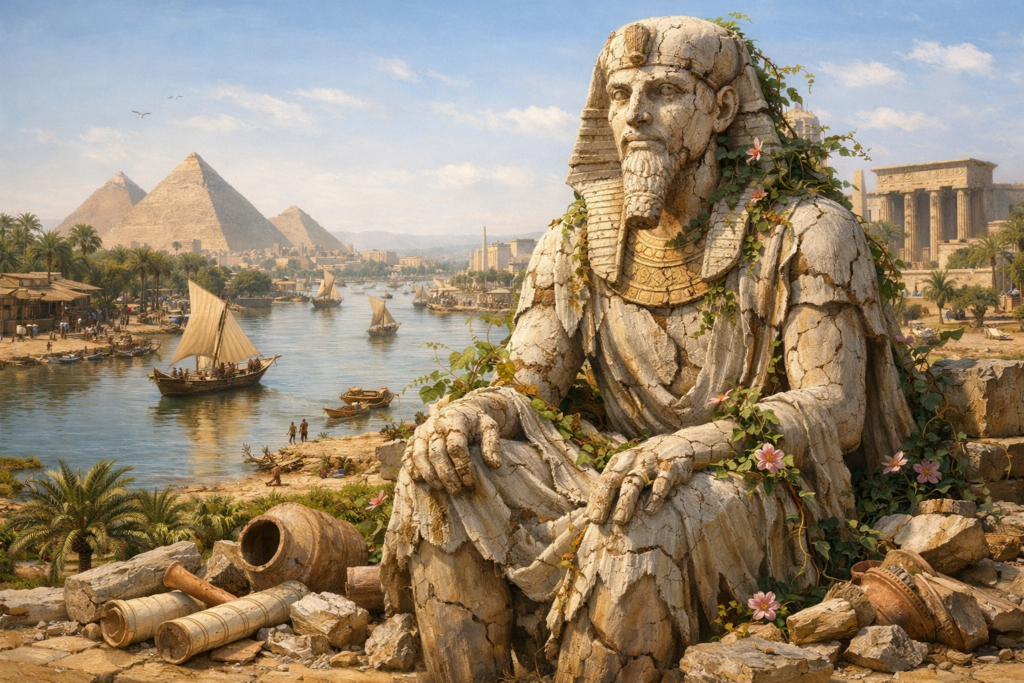
Not Knowing and the Start of Galut
We often assume that the Egyptian Exile [גָלוּת מִצְרַיִם, Galut Mitzrayim] began when Ya'akov and his family descended to Egypt during the years of famine. But that assumption does not fully align with what the Torah itself reveals. Ya'akov's family actually lived in relative peace, stability, and even prosperity for many years after his death. So when did galut actually begin?
The Torah points to at least two decisive moments – which are, in truth, two expressions of a single underlying cause – that together answer this question (Shemot 1:6, 8): וַיָּמׇת יוֹסֵף וְכׇל־אֶחָיו וְכֹל הַדּוֹר הַהוּא … וַיָּקׇם מֶלֶךְ־חָדָשׁ עַל־מִצְרָיִם אֲשֶׁר לֹא־יָדַע אֶת־יוֹסֵף (And Yosef died, and all his brothers, and that entire generation … and a new king arose over Egypt who did not know Yosef). What, precisely, do these two pesukim have in common?
To answer that, we must first clarify what it means 'to know' in the language of Torah. In Bereshit 4:1, we are told: וְהָאָדָם יָדַע אֶת־חַוָּה (And the man knew Chavah). Later, in Shemot 5:2, Pharaoh declares to Moshe and Aharon: לֹא יָדַעְתִּי אֶת־יְיָ וְגַם אֶת־יִשְׂרָאֵל לֹא אֲשַׁלֵּחַ (I do not know Hashem, and therefore I will not send out Yisrael). The shared usage of 'knowing' in these contexts shows that da'at does not describe information or awareness, but relationship. Therefore, when the Torah tells us that a new king arose who did not know Yosef, it is not describing factual ignorance, denial of contribution, or overt hostility. If any of those had been the case, the Torah would have said so. Rather, Pharaoh did not know Yosef – by design. He chose not to have any relational connection to him at all.
The Midrash gives precise language to this state (Shemot Rabbah 1:8): דַּהֲוֵי דָמֵי כְּמַאן דְּלָא יָדַע לֵיהּ לְיוֹסֵף כְּלַל (It was as if he were someone who did not know Yosef at all). Therefore, לֹא־יָדַע (he did not know) does not describe factual ignorance, but chosen non-recognition – an existential stance in which Yosef no longer functioned as being historically relevant.
This reading also clarifies the Torah's sequencing, specifically why Pharaoh's rise is juxtaposed with the death of the previous generation. As the Midrash further notes: לְלַמֶּדְךָ שֶׁכָּל זְמַן שֶׁהָיָה אֶחָד מֵהֶם קַיָּם מֵאוֹתָן שֶׁיָּרְדוּ לְמִצְרַיִם לֹא שִׁעְבְּדוּ הַמִּצְרִים בְּיִשְׂרָאֵל (To teach us that as long as even one of those who had descended to Mitzrayim was alive, the Egyptians did not enslave Yisrael). Living memory itself restrained the exercise of raw power. Galut – enslavement – was not possible as long as memory endured. Once memory died, structured galut followed automatically.
The death of memory the Torah describes is neither partial nor accidental. It is deliberate and total – national, institutional, political, societal, and personal. And it is precisely for this reason that it is more dangerous than open hostility. This is not ingratitude. Ingratitude still presumes awareness. One knows what is owed and suppresses that knowledge, often at the cost of inner tension or moral discomfort. But that is not the condition the Torah is describing here.
What the Torah describes, then, is not a failure of knowledge but a state of existence. Once Yosef was no longer known in the Torah sense, there was no suppressed awareness to contend with, no memory pushing back from within, and no inner resistance to what would follow. This is why the Torah's language is so sparse. It does not describe denial, conflict, or moral struggle, because they didn't exist. Not knowing Yosef did not require justification. It produced no inner friction. It allowed Egypt to move forward without ever needing to confront what had been severed.
Ignorance of this kind is not loud or aggressive. It is quiet, orderly, and complete. It does not argue with memory – it simply has none.
But in a healthy society, shared memory generates a sense of obligation, and obligation gives rise to reciprocity. People are not merely consumers; they see themselves as contributors within a shared structure of responsibility. And when that structure is strained – when reciprocity falters or obligation is suppressed – it is felt. Measured and appropriate embarrassment can arise, because embarrassment and shame exist only where shared memory still binds people together. But once memory disappears, the entire structure collapses. Obligation no longer asserts itself. Embarrassment no longer surfaces. And the protection ordinarily afforded to those who generate value quietly vanishes as well. Contribution ceases to function as a pathway to security, while consumption – taking without reciprocity – feels entirely innocent.
This is why a society in which memory has collapsed does not experience itself as cruel. It experiences itself as functional. Meaning is still admired. Depth is still recognized. Contribution is still enjoyed. But none of these generate responsibility. Value is consumed privately, while obligation is understood as optional or external – possibly even as radical behaviour. What once bound people together as participants in a shared story is reduced to isolated moments of appreciation, detached from any lasting claim. Admiration does not translate into support, benefit does not translate into protection, and recognition does not translate into reciprocity. In fact, people don't despise its benefactors. They do not remember them long enough to despise them. That's the death of memory. Once memory no longer binds, contribution becomes something to be taken rather than something that establishes standing. Those who produce value are rendered interchangeable, replaceable, and ultimately invisible.
In such a world, nothing feels broken. Systems continue to function. Life proceeds smoothly. But the logic has shifted: society now runs on consumption rather than covenantal relationships. What is taken leaves no trace, and what is given generates no response. This is not a modern pathology; it is Egyptian consciousness.
The Torah records no transition between not knowing Yosef and the enslavement of the Jewish people. There is no description of deliberation, no account of shame or inner conflict, no mention of suppressed guilt or moral turmoil. Nothing intervenes between these two realities. Why? Because there was nothing to intervene. Once Egypt decided to forget Yosef, nothing stood in the way of enslavement. This is why we can say that once shared memory dies, structured galut follows – automatically.
Seen this way, galut can be reframed, not only as a historical episode but as a recurring condition that follows a recognizable pattern. And to understand it clearly, we must first state what it is not. Galut does not begin with brutal cruelty or overt hatred. It is not even defined, at its outset, by institutionalized persecution. Rather, it begins when contribution no longer anchors its contributors, when memory no longer protects benefactors, and when consumption becomes so normalized that it replaces covenantal relationships. At that point, oppression no longer requires justification; it proceeds without friction. In other words, Egypt did not hate Yosef. It simply no longer remembered him. And once Yosef was no longer remembered, the Jewish People were already in exile.
The Torah does not linger on the question of what caused this collapse. It does not analyze motives, reconstruct psychology, or trace the path by which Yosef came to be forgotten. Those questions can be explored – but they are not the Torah's focus here. Instead, the Torah brings us directly into the new reality. Once memory no longer binds and galut has become institutionalized, the past no longer governs interpersonal interactions. At that point, the question is no longer how the world arrived here, but how one lives within it.
And the Torah's response is not to attempt a restoration of gratitude or a revival of memory. It does not appeal to sentiment, nor does it try to reawaken a conscience that no longer registers obligation. Rather, the Torah responds to structured galut with structured Torah – systems, obligations, and law. This is why Sefer Shemot does not unfold as a book of sermons, but as a book of construction. The Torah does not argue with a world shaped by exile. It builds a way to live within it.
In the end, it is memory that protects a society – not kindness, morality, or even gratitude. Human decency cannot be relied upon once memory becomes optional. Galut does not begin with cruelty or hatred; it begins with forgetfulness.