

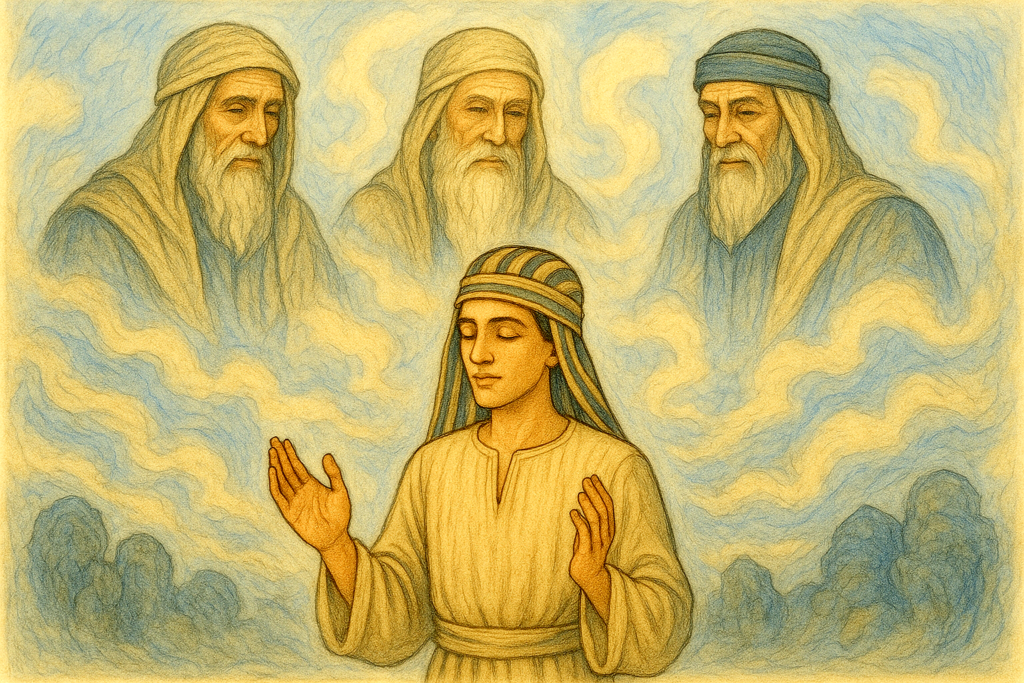
What the Komarna Rebbe Reveals About Yosef's Greatest Test
How was it possible for a young man, alone, enslaved, and far from home, to withstand the relentless seduction of the most powerful woman in his life? Yosef was good-looking, capable, and entrusted with full authority in Potiphar's house. On the surface, he could have done whatever he wanted without consequence. And this was not a single moment of temptation either. She pursued him day after day, aggressively and explicitly, as the pasuk records her saying (Bereshit 39:7): שִׁכְבָה עִמִּי (Lie with me).
Yet Yosef refused – not once, but with unwavering consistency, resisting temptation, manipulation, and even the threat to his position and survival. The Torah captures his entire stand with one word (Bereshit 39:8): וַיְמָאֵן (And he refused). This refusal became the turning point of his destiny. It was not merely personal. It was cosmic.
So what gave him the power to refuse when every natural force pulled him in the opposite direction?
Although many have sought to explain the depth of Yosef's refusal, the Admor from Komarna, in his monumental commentary on the Torah, Heichal ha-Brachah, expresses it with unique clarity and force: וימאן בתכלית המיאון ברעם וברעש ובקול ובצווחה וביראה גדולה (And he refused with absolute refusal – with thunder, and with trembling, and with voice, and with an outcry, and with great awe). Why does the Komarna Rebbe enumerate five expressions of refusal?
Let's look at them one at a time and see what we can uncover.
Thunder describes the sheer force of his refusal. His 'No!' landed like a thunderclap – clear, unmistakable, and uncompromising – indicating the intensity with which he set the boundary the very moment the proposition became explicit.
Trembling reflects what followed. Such a forceful stand carries consequences, and Yosef knew it. His entire position in the household was at risk. The trembling captures the inner shudder of someone who stands firm despite danger, yet refuses to retreat.
Voice points to the reasons he gave her – the betrayal of his master's trust, the moral degradation of the act itself, and the ultimate offense against G‑d (Bereshit 39:8-9). Voice literally refers to his spoken words, turning his visceral reactions into conscious holy speech.
Outcry expresses the raw emotional surge behind his stance. Even after giving clear reasons, something deeper erupted – the fierce cry of a person pushed to the edge of human capacity, who screams with total urgency: 'I must not fall – I will not fall!'
Finally, a great awe settled upon him – the awareness that Hashem was with him in that moment. He was not alone. He knew that he stood before Hashem, and no desire or pressure could override that truth.
So why davka five expressions of refusal? Because they correspond to the five ascending levels of the soul. Thunder is the blunt shock of contact with the trial, the immediate jolt that strikes the nefesh. Trembling follows as the inner winds are shaken, the emotional movement of the ruach. Then comes voice, the moment Yosef gives form, clarity, and moral meaning to his refusal – an activation of neshamah. Outcry breaks forth next, the eruptive surge of vitality that pushes back against collapse, the living force of chayah. Finally, great awe settles over the moment – the quiet, steadfast awareness of standing before Hashem, the unbroken point of yechidah where the soul aligns fully with the Oneness of the Ribbono shel Olam.
Yosef's refusal was something we cannot truly imagine because he tapped into and unified all five aspects of his soul at once – a level of inner mastery far beyond where most of us stand today.
But even this rise through the five levels of the soul was not, for the Komarna Rebbe, the whole story. It describes Yosef's avodah, but not yet the deeper source that made it possible. To reveal that source, the Rebbe adds one final, decisive teaching. After describing Yosef's inner mastery, he closes with a statement that reshapes our understanding of the entire episode: ובהתקשרות ביעקב חבל נחלתו שלשלת אבות (And with an attachment [hitkashrut] to Ya'akov, the portion of his inheritance, the chain [shalshelet] of the forefathers).
The inescapable conclusion is that Yosef could not have withstood this test without connecting himself to the tzaddik – to his father Ya'akov and to the rest of the chain of the Avot, Yitzchak and Avraham. All of Yosef's superhuman effort, his personal kedushah, and even his ascent through all five levels of the soul would not have been enough on their own. What led the Admor to this conclusion? The very word the Torah uses for Yosef's refusal – וַיְמָאֵ֓ן – shown here with the שַלְשֶלֶת [shalshelet] trope above the א. Shalshelet means 'chain,' exactly as the Admor from Komarna says: shalshelet Avot. Yosef's hitkashrut to the tzaddik – his place on that chain – is what empowered his efforts and brought them to fruition.
This reading aligns perfectly with the heart of Breslov chassidut, which explains why such connection is indispensable. R' Nachman said many times that no one can succeed in true avodah without being connected to the tzaddik. From him come emunah, simchah, teshuvah, and the guidance that reveal a person's path. And when facing temptation, Rabbeinu teaches that real strength comes only through hitkashrut to the true tzaddikim, those lying in the dirt and those living in our generation. That is precisely what Yosef drew upon when he attached himself to the shalshelet of Ya'akov, Yitzchak, and Avraham.
Without the tzaddik, a person is pulled down into confusion, despair, and self-doubt. With the tzaddik, a person becomes rooted in the ancestral shalshelet and acquires strength far beyond his natural capacity – exactly like Yosef, who stood in his test because he plugged himself into the chain from Ya'akov, back to Yitzchak, and ultimately back to Avraham, the shalshelet of the Avot. It's not a slogan. It's a directive – something we must actually put into practice. Human effort is necessary, but never sufficient. The actual power comes from the tzaddik.
And once this principle is understood, the Torah reveals an even deeper mystery hidden in the very word וַיְמָאֵן itself.
The word וַיְמָאֵן appears twice in this parashah – once with Yosef and once with Ya'akov. When Ya'akov was told Yosef had died, the Torah says (Bereshit 37:35): וַיָּקֻמוּ כׇל־בָּנָיו וְכׇל־בְּנֹתָיו לְנַחֲמוֹ וַיְמָאֵן לְהִתְנַחֵם (And all his sons and all his daughters rose up to comfort him, and he refused to be comforted). Rashi explains that such refusal was unnatural because the Heavenly decree that softens mourning applies only to one who is truly dead. Since Yosef lived, that decree never took effect, leaving Ya'akov in a state of perpetual grief no human could naturally bear.
And Yosef's refusal was equally unnatural. A young, isolated slave should have fallen immediately, yet he did not – and the Torah uses the same exact word, וַיְמָאֵן. This is the key: Ya'akov's refusal became the spiritual engine of Yosef's refusal. As the father refused to give up on his son, the son refused to give up on himself. And both refused to accept the 'outer' reality, sensing that outside the darkness there must be hidden light.
Here the Torah reveals a single inner strength flowing through both of them. Ya'akov cannot be comforted because Yosef's destiny burns within him, and Yosef cannot sin because his father's faith burns within him. Their refusals arise not from calculation but from identity – two expressions of one covenantal force, preserving the future of Am Yisrael.
In the end, Yosef’s וַיְמָאֵן and Ya'akov’s וַיְמָאֵן are not two refusals at all, but one. Ya'akov’s refusal to release his son became the spiritual current that empowered Yosef to refuse the temptation that could have destroyed him. Both stand on the same foundation: the shalshelet of the Avot. This is the mystery the Rebbe from Komarna exposes: human effort, even elevated through all five layers of the soul, becomes invincible only when it is joined to the tzaddik and the chain of generations. Yosef did not stand because he was strong; he stood because he was connected.
And so the Torah ends the matter by teaching us that our own victories, too, come not from isolation but from the line we choose to hold onto, and the holy refusals we are willing to make along the way.

One Response
The word וימאן has a cantillation over it, an unusual Shalshelet. A long undulating sound. Yosef does not immediately bolt from Potophar’s wife, who is urging him to lie with her. It indicates a long hesitation and inner struggle within him. All understandable given the circumstances. His Yetzer Hatov wins and he is called Yosef Hatzadik for winning this unbelievable temptation.