How Shem and Yefet's Act Traces Modesty Through the Soul
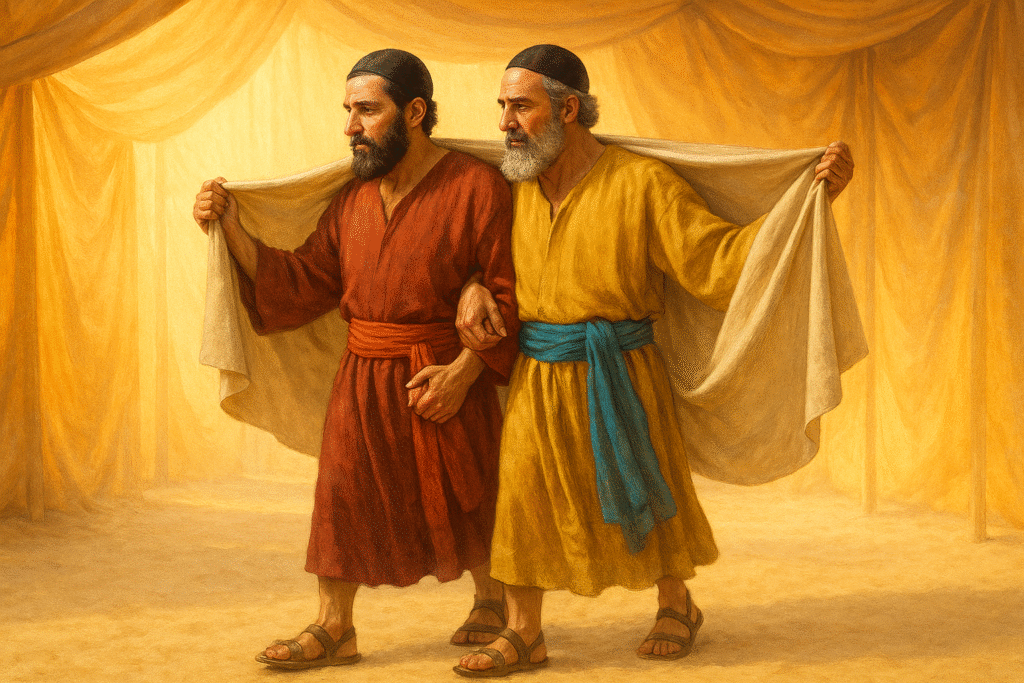
The Torah lingers on a moment that seems, at first, entirely straightforward (Bereshit 9:23): וַיִּקַּח שֵׁם וָיֶפֶת אֶת־הַשִּׂמְלָה וַיָּשִׂימוּ עַל־שְׁכֶם שְׁנֵיהֶם וַיֵּלְכוּ אֲחֹרַנִּית וַיְכַסּוּ אֵת עֶרְוַת אֲבִיהֶם וּפְנֵיהֶם אֲחֹרַנִּית וְעֶרְוַת אֲבִיהֶם לֹא רָאוּ (And Shem and Yefet took the garment, and they placed it upon both their shoulders, and they walked backward, and covered their father's nakedness, and their faces were turned backward, and their father's nakedness they did not see). If they walked backward, do we not know that their faces must have been backward? And if their faces were turned backward, do we not know that they didn't see their father's nakedness? Why this three-fold repetition?
Almost all of our Sages pause here, as if hearing in these extra words something deeper – a choreography of kedushah unfolding step by step. Beneath the surface act of covering Noach lies a map of the soul: the instinctive movement of the body, the stirrings of awe, the turning of the face to protect the tzelem Elokim, and the quiet mastery of the eyes themselves. In this single pasuk, the Torah records not only an act of modesty, but the way each level of a person's soul can align in reverence before the Divine image in another.
Let's begin with the Midrash (Bereshit Rabbah 36:6): מִמַּשְׁמַע שֶׁנֶּאֱמַר וַיֵּלְכוּ אֲחֹרַנִּית, אֵינִי יוֹדֵעַ שֶׁעֶרְוַת אֲבִיהֶם לֹא רָאוּ, אֶלָּא מְלַמֵּד שֶׁנָּתְנוּ יְדֵיהֶם עַל פְּנֵיהֶם וְהָיוּ מְהַלְּכִין לַאֲחוֹרֵיהֶם, וְנָהֲגוּ בוֹ כָּבוֹד כְּמוֹרָא הָאָב עַל הַבֵּן (From the fact it already says, 'And they walked backwards' do I not know that they did not see their father's nakedness? Rather, it teaches that they placed their hands upon their faces and walked backward, and they behaved toward him with honor, like the reverence that a son owes his father). Now why would a son place his hands over his face and then walk backward? We can ask the same question we asked above: if the sons are already walking backward, why do they need to cover their faces?
The Midrash is focusing on the reflexive awe the sons felt toward their father. Their covering of their faces with their hands is instinctive, arising from a place of shame and reverence, the body itself recoiling from the sight of their father's disgrace. Even before thought or calculation, their limbs obey the soul's sense of modesty. But don't misunderstand. This isn't yet an act of conscious piety. It is instinctual – much like the way a person automatically turns away from a foul odor. The hands, moved by awe rather than deliberation, become the first guardians of honor. In that instant, their physical gesture reveals a profound spiritual reflex: even the simplest human movement can express kavod when it springs from natural reverence. The Midrash teaches that kedushah begins with pure instinct – the body's simple refusal to look where it shouldn't. This is the kedushah of the nefesh – the lowest part of the soul where even the body's impulses can learn to bow before what is holy.
Yet, instinct alone does not complete our picture. The same gesture that began as natural reverence needs to unfold as will – in the ruach, where modesty becomes a chosen act expressing a mitzvah of kavod. Noting that Bereshit 9:23 begins with the word וַיִּקַּח [and he took] instead of וַיִּקְחוּ [and they took] – which we would have expected the Torah to have used – Rashi writes: לִמֵּד עַל שֵׁם שֶׁנִּתְאַמֵּץ בַּמִּצְוָה יוֹתֵר מִיֶּפֶת (This teaches concerning Shem, that he exerted himself in the mitzvah more than Yefet). What mitzvah? Clearly, the mitzvah of כִּבּוּד אָב וָאֵם (Honor father and mother). Without getting too far afield, even though the mitzvah of kibbud av va'eim isn't technically one of the seven mitzvot of B'nei Noach, Rashi considers it an eternal moral law – a Divine obligation woven into human existence, revealed here through Shem's intuitive reverence for his father's dignity – something which any sensitive person should easily recognize as a moral imperative rooted in his soul's connection to G‑d.
Whereas the Midrash speaks of instinct and spontaneous awe, Rashi shifts our attention to conscious moral intent, i.e., to a mitzvah. Shem 'exerted himself,' applying will and awareness to what the body already did instinctively. This is the work of the ruach: not simply to feel reverence, but to radiate it outward through deliberate action. In practice, this means that their hands did not only recoil to cover their face from the sight of seeing the shame of their father, but they behaved with concerted effort – consciousness drove their actions. They took hold of the garment, coordinated their movements, and restored Noach's dignity.
We see this expressed by the repetition of the words וַיֵּלְכוּ אֲחֹרַנִּית (they walked backward) and וּפְנֵיהֶם אֲחֹרַנִּית (and their faces were turned backward). Rashi asks why is אֲחֹרַנִּית mentioned twice? His answer: מְלַמֵּד שֶׁכְּשֶׁקָּרְבוּ אֶצְלוֹ וְהֻצְרְכוּ לַהֲפֹךְ עַצְמָם לְכַסּוֹתוֹ הָפְכוּ פְנֵיהֶם אֲחוֹרַנִּית (This teaches that when they drew near to him and needed to turn themselves to cover him, they turned their faces backward). It wasn't that they turned their faces again, but rather they turned their faces more, keeping their faces completely turned away from Noach's body – not out of fear, but to fulfill the mitzvah.
But beyond mitzvah lies the recognition of the tzelem Elokim within – the level of the neshamah. How is this deeper aspect of modesty encoded in the pasuk? To answer this question we turn to the Alshich. Whereas the Midrash and Rashi focus on the repetition of אֲחֹרַנִּית, the Alshich focuses on the final words in the pasuk: וְעֶרְוַת אֲבִיהֶם לֹא רָאוּ (and their father's nakedness they didn't see). He asks, Why didn't they just close their eyes and walk forward? Wouldn't that have been easier and yet, just as effective? The Alshich explains: כי אין צריך לומר עיניהם, כי אם גם פניהם הנזכר לא ראו ערות אביהם. שאומר ראו, חוזר אל פניהם הנזכר, ותצדק בהם ראייה כדאמרו בלשון רבותינו זכרונם לברכה (ברכות דף כ״ה): לבו רואה את הערוה. והוא כי הלא צדיקים היו וצלם אלקים על פניהם, ולא רצו שפניהם אשר בם קדושת צלם אלקים יראו את הערוה גם שיטמטמו עיניהם (For it wasn't necessary to say 'their eyes,' but rather also 'their faces' as mentioned did not see their father's nakedness. The word רָאוּ [they saw] refers back to 'their faces' as mentioned and 'seeing' is pertinent to them, according to the language of our Rabbis of blessed memory (Berakhot 25): 'His heart sees the nakedness.' For indeed, they were tzaddikim, and the tzelem Elokim was upon their faces, and they did not want their faces, in which the kedushah of the tzelem Elokim was present, to 'see' the nakedness – even if they closed their eyes). The Alshich is redefining modesty not as a matter of the eyes alone but as something that reaches to the face itself – to the פָּנִים [panim, face] that bears the tzelem Elokim.
The panim mentioned here in the Torah is not just what we normally think of when we hear the word 'face,' i.e., flesh and bone covered with skin. Rather, it includes the holy countenance of man – the outward revelation of the neshamah. This explains why panim is, by nature, a plural word. To guard one's face, then, is to guard the tzelem Elokim within – the radiance of the Divine image shining out from the inner soul. Modesty relates not only to the guarding of the eyes, but to the guarding of the face, to one's holy neshamah, so that it not recoil from impurity. The Divine image can only turn toward purity and kedushah, and when exposed to shame, its light contracts. A spiritual radiance shines from a holy face, yet that light cannot coexist with tumah; in its presence, the holy light draws back, as if the unholy fire of impurity scorches and extinguishes it.
Although the Alshich teaches us that true modesty begins not in the eyes but in the face – in the panim, the revealed light of the neshamah, the Torah's description carries us one step further. Let us now see how this inner modesty extends throughout the entire body, until every point of motion becomes an act of restraint and every joint a vessel of kedushah.
If we pause to consider, we can see that the Torah describes a movement that was not really movement at all. They walked like a beam of light, refusing every invitation to bend, to see, to know. Each joint became a point of surrender, every body part that could swing right and left, a gate of modesty. Their hips did not pivot – in order to protect the kavod of their father – and their necks did not turn – in order to preserve the tzelem Elokim from defilement. But as brought out in Sefer Shemirat Einayim (Shemirat Ohr Panim), the pasuk alludes to a deeper level. The eyes – the smallest and most active 'pivot point' remained still. The eye muscles froze, preventing any motion to the right or to the left. This is the inner meaning of the closing words: וְעֶרְוַת אֲבִיהֶם לֹא רָאוּ (And they did not see their father's nakedness).
At first glance, this means that Shem and Yefet did not look – but we already know that. Rather, it comes to describe a total cessation of seeing: not only their persons and faces, but even their eyes did not see. The faculty of sight itself came to rest. This is the ascent beyond nefesh, ruach, and neshamah – into the chayah, where motion ceases but awareness still exists, and beyond that into the yechidah, where awareness dissolves in absolute unity (see the first beggar in R' Nachman's story The Seven Beggars). The body's stillness becomes the soul’s stillness, and the eyes no longer guard – they simply rest in unity with the Infinite Oneness.
In conclusion, if this was the reverence with which Shem and Yefet turned from their father's shame, how much more should we guard our eyes, our gestures, and even our panim before others – especially between men and women, where the tzelem Elokim in the other calls for deeper restraint and respect.